AI digital twins simulate real-world systems by combining real-time data, machine learning, and physics-based models into synchronized virtual replicas of physical assets.
They sit at the intersection of IoT-enabled monitoring, artificial intelligence, and advanced visualization – and they are changing how business leaders, operations managers, industrial engineers, and healthcare providers run their organizations.
The market is growing fast. The global digital twin market is projected to surge from USD 24.5 billion in 2025 to USD 259.3 billion by 2032 – driven by demand for smarter prediction, greater efficiency, and scalable infrastructure modeling across every major industry.
| 92% of companies deploying digital twins report ROI above 10% – with over half reporting at least 20%Hexagon, 2025 |
What Are AI Digital Twins?
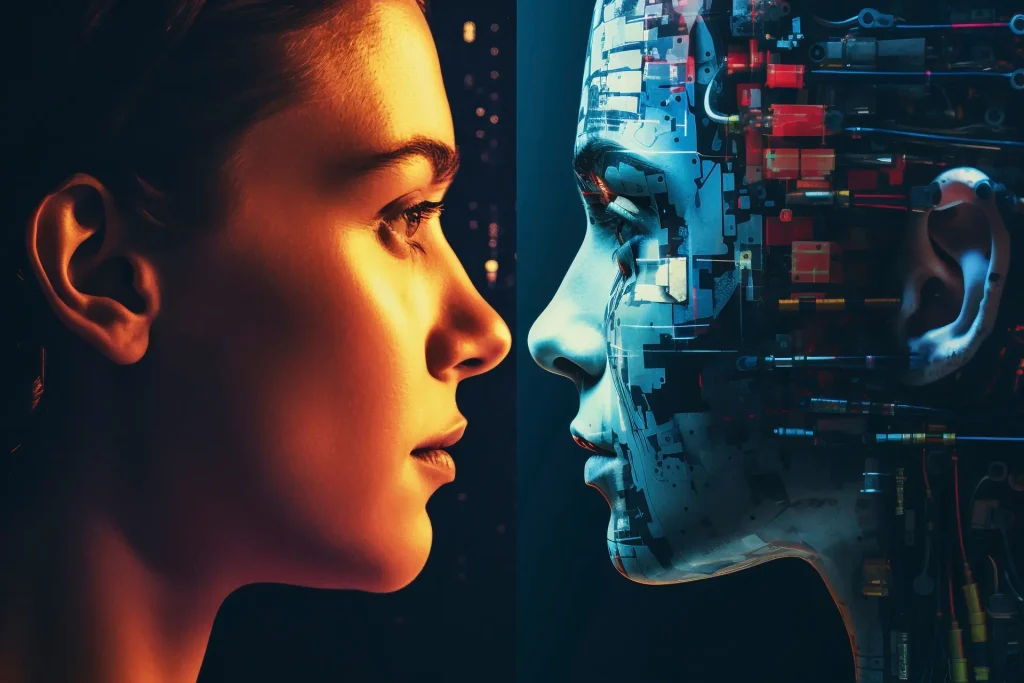
At their core, AI digital twins are virtual replicas of physical objects, processes, or systems. What sets them apart from traditional simulations is their connectivity.
A conventional simulation runs a predefined scenario and then stops. An AI digital twin stays connected to its physical counterpart through IoT sensors and data pipelines – and it never stops learning.
Sensors collect operational data continuously – temperature, pressure, output rates, error signals – and stream it into the digital model in real time.
AI models then analyze that data to recognize patterns, detect anomalies, and project future states. The result is a system that does not just reflect what is happening but tells you what is likely to happen next.
Synchronization aligns virtual and physical systems so that every change in the real world is reflected almost instantly in the digital model. This tight synchronization is what gives AI digital twins their predictive power.
| Key Difference: Simulation vs. AI Digital TwinA simulation is static – it runs a scenario once with no live link to the real world. An AI digital twin is dynamic: it updates continuously, learns from new data, and can initiate actions in the physical system. Synchronization is the core distinction. |
How Do AI Digital Twins Work?
The intelligence inside an AI digital twin comes from several integrated layers working together. Understanding each layer helps explain why these systems are so powerful – and so different from anything that came before.
IoT-Enabled Monitoring and Data Collection
Everything starts with data. IoT specialists deploy networks of sensors across physical assets – factory floors, hospital equipment, energy grids, or urban infrastructure.
These sensors collect operational data continuously and send it to the digital model through a secure data pipeline. The quality and volume of this data directly determine how accurate the twin’s predictions will be.
Adaptive Machine Learning Models
Once data arrives, adaptive machine learning models go to work. Machine learning predicts system behavior by identifying patterns across millions of data points – far more than any human team could analyze manually.
Over time, these models learn the normal operating signature of each asset. When something shifts, anomaly detection capabilities flag the change before it becomes a failure.
AI models adapt to changing environments – which is critical in industrial settings where conditions are never perfectly stable. A machine learning model trained on summer operations will update itself as winter changes load patterns, material properties, or energy demands.
Predictive Analytics Integration
Predictive analytics integration allows the twin to run forward-looking scenario simulations. Instead of simply reporting current performance, the twin asks:
- What happens if this valve fails?
- What happens if production volume increases 20%?
- What is the most efficient maintenance window over the next 90 days?
Digital replicas optimize asset performance by continuously running these what-if calculations in the background.
Interactive Data Visualization
Data scientists and operations managers interact with the twin through interactive data visualization dashboards. These interfaces translate complex simulation outputs into clear, readable graphics – heat maps, performance trend lines, 3D asset models, and anomaly alerts.
Visualization makes it possible for business leaders without deep technical backgrounds to act on the twin’s insights directly.
Automated Workflow Optimization
Perhaps the most powerful feature is automated workflow optimization. Automation streamlines industrial workflows by allowing the twin to do more than recommend – it can act.
When the AI detects that a component is approaching failure, it can automatically schedule a maintenance ticket. When energy demand spikes, it can redistribute load across the grid. When production bottlenecks form, it can adjust sequencing without human intervention.
What Industries Benefit from AI Digital Twins?
AI digital twins are already transforming operations across a wide range of sectors. The common thread is complexity – any industry managing large, interconnected physical systems with real consequences for failure stands to gain.
| Industry | How AI Digital Twins Help |
| Manufacturing | Manufacturers use process twins to model entire factory floors. Automation streamlines industrial workflows, reduces downtime, and enables predictive maintenance that prevents costly production halts. |
| Energy & Utilities | Infrastructure twins visualize network operations across power grids and pipelines. AI predicts demand surges, detects faults, and optimizes distribution – boosting reliability and efficiency. |
| Healthcare | Healthcare providers use patient-level digital twins to model disease progression and simulate treatment outcomes before prescribing. Hospital facility twins optimize staffing and equipment scheduling. |
| Aerospace & Defense | Engineers test aircraft components, structural materials, and flight dynamics in simulation before any physical prototype is built – reducing both cost and certification time. |
| Smart Cities | Urban planners use city-scale digital twins to model traffic, utilities, and environmental systems. Policies and infrastructure changes are tested virtually before real-world deployment. |
| Supply Chain | Operations managers simulate disruption scenarios – port closures, supplier failures, demand spikes – and test response strategies without real-world risk. |
How Are IoT Devices Connected to Digital Twins?
IoT specialists build the data backbone that makes AI digital twins function. Physical sensors are attached to assets – or embedded in smart devices that come pre-equipped – and configured to stream data to a cloud or edge processing layer. That layer normalizes and validates the data before passing it to the virtual model.
Interoperability is a key challenge here. Large industrial environments may have thousands of sensors from dozens of manufacturers, all generating data in different formats.
Modern AI digital twin platforms solve this through standardized data protocols and middleware layers that translate sensor output into a unified format that the AI models can consume.
Connectivity between the IoT layer and the digital twin is not just one-directional. The feedback loop runs both ways: the twin’s AI can push control signals back to physical systems – adjusting a valve, slowing a conveyor, or triggering a shutdown – based on what it predicts will happen next.
This bidirectional connectivity is what turns a monitoring system into an intelligent, responsive control system.
| Responsiveness in ActionMonitoring systems detect anomalies in real time. A digital twin connected to a manufacturing line can identify a micro-vibration pattern associated with bearing wear, calculate the probability of failure within 72 hours, and automatically generate a work order – all before a human operator sees anything unusual. |
How Do Digital Twins Use Artificial Intelligence?
AI is what separates a digital twin from a standard 3D model or a basic monitoring dashboard. Several layers of AI work together inside a modern AI digital twin:
- Machine Learning: Machine learning predicts system behavior by training on historical and real-time operational data. Supervised learning models learn what failure looks like; unsupervised models detect patterns no one thought to look for.
- Generative AI: Large language models can generate synthetic training data to fill gaps in historical records, accelerate twin development, and serve as a natural-language interface – letting non-technical users query complex simulation results in plain English.
- Reinforcement Learning: Some advanced twins use reinforcement learning to discover optimal operational strategies by trial and error in the virtual environment with zero risk to the physical system.
- Computer Vision: Visual inspection systems integrated with the twin analyze camera feeds to detect surface defects, assembly errors, or environmental hazards in real time.
Analytics improve operational efficiency by synthesizing outputs from all these AI layers into a single, prioritized action queue for human operators. Rather than drowning teams in data, the twin surfaces only what matters most.
How Do AI Digital Twins Improve Predictive Maintenance?
Predictive maintenance is one of the clearest and most measurable applications of AI digital twins. Traditional maintenance operates on a fixed schedule – service every 30 days, replace every 6 months – regardless of the actual condition of the equipment. This approach either over-maintains (wasting money) or under-maintains (risking failure).
AI digital twins flip this model. How do AI digital twins improve predictive maintenance? By doing what human inspection cannot: monitoring every component continuously, learning its normal performance signature, and calculating the remaining useful life in real time.
When the AI predicts that a bearing is likely to fail within 48 hours, maintenance is scheduled precisely – not too early, not too late.
Scalable infrastructure modeling means this approach works at any scale – from a single conveyor belt to a network of thousands of assets spread across a global operation.
The twin tracks each one individually, while simultaneously modeling how a failure in one might cascade through the others.
Operational performance tracking provides the continuous data stream that makes this possible. Every run cycle, every temperature reading, every output measurement becomes a data point that sharpens the AI’s prediction accuracy over time. The longer the twin runs, the smarter it gets.
| Predictive maintenance enabled by digital twins reduces unplanned downtime by up to 50% and extends asset life by 20–40%McKinsey & Company |
How Are AI Digital Twins Used in Smart Cities and Healthcare?
Smart Cities
Urban planners face one of the most complex optimization challenges in existence: managing millions of interconnected systems – roads, transit, water, energy, emergency services – that affect millions of people simultaneously.
AI digital twins give them a safe environment to test changes before committing real-world resources.
A smart city twin might synchronize data from traffic sensors, utility meters, weather stations, and public transit systems into a single integrated simulation environment.
Urban planners can then test how a new bus route affects congestion, how a solar farm affects grid stability, or how a flood event stresses the drainage system – all in the virtual world before spending a single dollar on infrastructure.
Infrastructure twins visualize network operations at a city scale, giving planners and engineers a live, interactive map of how systems interact.
This level of intelligence was simply not possible before AI digital twins made real-time simulation at scale feasible.
Healthcare
Healthcare providers are using AI digital twins in two powerful ways: at the patient level and at the facility level.
At the patient level, a digital twin models an individual’s physiology – organ function, disease progression, drug metabolism – using their personal health data.
Clinicians can then simulate how a treatment plan is likely to perform for that specific patient before prescribing it. This is a fundamental shift toward personalized, data-driven medicine that reduces trial-and-error in care delivery.
At the facility level, hospital twins model staffing, scheduling, equipment use, and patient flow. Operations managers can simulate the impact of adding a new ICU wing, changing shift patterns, or responding to a sudden influx of emergency cases – without disrupting real operations.
Analytics improve operational efficiency by surfacing the best resource allocation strategies before they are needed.
What Software Platforms Support AI Digital Twins?
Software architects and AI engineers have a growing ecosystem of platforms to choose from. Each offers different strengths depending on the use case, scale, and industry:
- NVIDIA Omniverse: A physics-based simulation platform built for industrial AI and digital twins. Powers virtual replicas with PhD-level physics, biology, and materials science models – used by automotive, aerospace, and life sciences companies.
- IBM Maximo Application Suite: An AI-powered asset management platform that integrates digital twin capabilities with IoT data, predictive maintenance workflows, and enterprise resource systems.
- Microsoft Azure Digital Twins: A cloud-based platform for building scalable, enterprise-grade digital twin environments with strong connectivity to Azure IoT, AI, and analytics services.
- Siemens Xcelerator / Teamcenter: A modular industrial digital twin suite used heavily in manufacturing, energy, and aerospace for product lifecycle management and simulation.
- Dassault Systèmes 3DEXPERIENCE: Offers virtual twin and industry world model capabilities with integrated AI physics – enabling design, simulation, and certification in one platform.
Software architects evaluating these platforms should assess interoperability with existing sensor infrastructure, support for adaptive machine learning models, scalability, and the availability of pre-built industry-specific world models that reduce development time.
What Are the Challenges of Implementing Digital Twins?
AI digital twins deliver significant value – but they also come with real implementation challenges. Understanding these challenges upfront helps organizations avoid the most common failure modes.
- Data Quality: Sensors collect operational data continuously, but that data is only useful if it is accurate, complete, and properly labeled. Poor data produces poor predictions. Investing in data infrastructure is not optional.
- Integration Complexity: Large environments may have legacy systems, proprietary sensor protocols, and siloed data stores. Achieving true interoperability across all these inputs requires serious software architecture work.
- Model Drift: AI models adapt to changing environments – but they need ongoing monitoring to ensure they are still accurate. A model that was well-calibrated a year ago may produce misleading outputs as conditions evolve.
- Security and Privacy: Bidirectional connectivity between digital and physical systems creates new attack surfaces. Any system capable of sending control signals to physical infrastructure must be secured accordingly.
- Organizational Readiness: Technology alone is not enough. Business leaders must ensure that teams have the skills, processes, and change management support to act on the insights the twin produces.
The good news is that Digital Twin as a Service (DTaaS) models are lowering the barrier to entry significantly. Organizations can now deploy enterprise-grade AI digital twins through the cloud – with managed infrastructure, pre-trained models, and scalable architecture – without building everything from scratch.
What Is the Difference Between Simulation and Digital Twins?
This is one of the most common questions from business leaders and operations managers exploring these technologies for the first time. The distinction matters because it shapes how you architect your investment.
| Traditional Simulation | AI Digital Twin |
| Static – runs predefined scenarios once | Dynamic – updates continuously with live data |
| No live connection to the physical world | Synchronized virtual replica of the real asset |
| Analyzes a single point in time | Models performance across the full asset lifecycle |
| Requires manual input to run new scenarios | Runs scenarios autonomously based on real-time triggers |
| Output is a report or model | Output includes real-time alerts, recommendations, and automated actions |
| Useful for design and planning phases | Useful across design, production, operations, and maintenance |
The Road Ahead for AI Digital Twins
AI digital twins are not a future technology. They are operational today in factories, hospitals, power grids, and city infrastructure around the world. What is changing rapidly is their intelligence, adaptability, and scalability.
The organizations that will lead their industries in the next decade are the ones building their AI digital twins today. Automation streamlines industrial workflows, machine learning predicts system behavior, and digital replicas optimize asset performance – but only for the organizations willing to make the investment now.
Frequently Asked Questions
AI digital twins are synchronized virtual replicas of physical objects, systems, or processes. They use IoT-enabled monitoring, adaptive machine learning models, and predictive analytics integration to mirror real-world conditions in real time – and to predict future states before problems occur.
Analytics improve operational efficiency by continuously processing sensor data, detecting performance deviations, and surfacing automated recommendations. Operations managers can act on insights faster, reduce unplanned downtime, and optimize resource use without expanding headcount.
Urban planners use city-scale AI digital twins to model traffic, utilities, and infrastructure – testing policy changes virtually before real-world deployment. Healthcare providers use patient-level twins to simulate treatment outcomes and facility-level twins to optimize hospital operations.
A simulation runs a static, predefined scenario with no live connection to the real world. An AI digital twin is a continuously updated, synchronized virtual replica that learns from real-time data, generates autonomous predictions, and can initiate actions in the physical system.
The main challenges include data quality and infrastructure, system interoperability, AI model drift, cybersecurity risks from bidirectional connectivity, and organizational readiness. DTaaS platforms are lowering many of these barriers by providing managed, scalable infrastructure out of the box.