As enterprises invest in AI, the real bottleneck is no longer building individual agents. It is orchestrating them at scale.
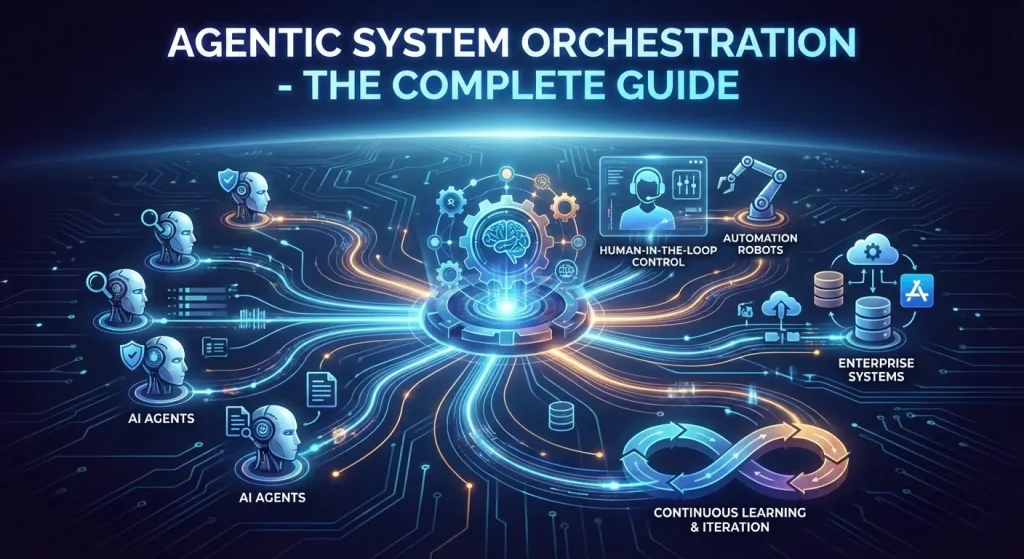
Agentic system orchestration is the technology framework that coordinates AI agents, robotic automation, and human workers within end-to-end business processes.
Instead of running isolated tasks in sequence, an agentic system orchestration layer lets agents communicate, collaborate, and make decisions across every system in your organization – all while keeping humans in control.
This guide breaks down how agentic system orchestration works, what makes it different from traditional automation, and how your organization can use it to reduce process time by 30 to 50 percent, cut task-switching overhead, and build a foundation for enterprise-scale AI operations.
What Is Agentic System Orchestration?
Agentic system orchestration enables enterprises to design, deploy, monitor, and optimize long-running AI workflows at scale. It integrates process orchestration, AI decision engines, system integrations, and governance controls into one coordinated platform.
- Action execution across systems: AI agents are empowered to take real actions – not just respond with text – across multiple enterprise applications.
- End-to-end workflow control: The orchestration layer routes tasks, manages state, and adapts workflows in real time as conditions change.
- Event-driven AI responses: The system continuously monitors business triggers and dispatches agents without waiting for human input.
- Continuous learning and iteration: Agents learn from each completed workflow, improving their reasoning capability and decision-making accuracy over time.
This is not a traditional chatbot. Agentic system orchestration is a distributed system that coordinates multiple agents in parallel, manages inter-agent communication protocols, and enforces policy-based governance controls at every step.
Process Orchestration vs. Agentic System Orchestration
Traditional process orchestration coordinates people and automation across defined workflows. Agentic orchestration builds on that foundation and adds a layer of AI-powered decision logic, dynamic model routing, and autonomous workflow execution. Here is how they differ:
| Capability | Process Orchestration | Agentic Orchestration |
|---|---|---|
| Decision-making | Rule-based, static logic | AI-powered, adaptive |
| Agent coordination | None | Multi-agent collaboration |
| Workflow adaptation | Rigid, pre-defined flows | Dynamic workflow adaptation |
| Learning | None | Self-learning from outcomes |
| Governance | Basic audit logs | Policy-based governance controls |
| Human involvement | Manual triggers | Human-in-the-loop control |
How Agentic System Orchestration Works: Architecture Overview
A well-designed agentic orchestration layer is a composable, modular system. Each component plays a defined role, and together they create a fault-tolerant, scalable distributed architecture that supports real-time execution across your entire enterprise.
Core Components
- Orchestration Engine: The central execution engine that runs AI tasks, manages system state, routes decisions between agents, and handles event-driven workflow execution. It coordinates scheduling, parallelism, and error recovery.
- AI Agents: Autonomous digital workers with reasoning capability. Each agent handles specific tasks – document analysis, fraud detection, and scheduling – and can communicate with other agents via inter-agent communication protocols.
- Integration Layer: API connectors and middleware that bridge modern AI with legacy systems, SaaS platforms, and internal databases. This is what makes the orchestration system interoperable across your entire stack.
- Memory Management System: Stores contextual workflow state across long-running processes. Memory-augmented reasoning allows agents to reference earlier steps, user preferences, and historical outcomes without starting from scratch.
- Data Pipelines: Structured channels that move data between agents, systems, and decision engines cleanly and without bottlenecks. Real-time processing keeps every component synchronized.
- Human-in-the-Loop Control: Escalation logic that brings human decision-makers into the process exactly when needed – no more, no less. Agents can request expert validation or route exceptions automatically.
- Policy-Based Governance Controls: A dedicated governance layer that enforces compliance rules, limits agent permissions, generates audit trails, and ensures every automated action is observable, traceable, and interruptible.
- Monitoring and Observability: Real-time dashboards and observable system telemetry that track agent performance, flag anomalies, and provide the data needed for continuous optimization.
How Tasks Flow Through the System
Here is a simplified view of how an orchestrated workflow moves through a real business process:
- A trigger initiates workflow events – a new customer request, a file upload, a system alert, or a scheduled task fires the orchestration engine.
- The planner decomposes the complex goal into specific sub-tasks and assigns each to the appropriate agent based on capability and availability.
- Agents execute their tasks in parallel or in sequence, using dynamic tool invocation to interact with external APIs, databases, and services.
- The decision engine evaluates inputs and outputs at key checkpoints, applying AI-powered decision logic to determine the next step.
- If confidence is low or a rule threshold is triggered, human-in-the-loop control kicks in and routes the task to a knowledge worker.
- Memory stores contextual information from each step, so the system builds on prior context rather than losing it.
- Monitoring tracks agent performance in real time, and governance ensures safe execution at every stage.
Key Capabilities That Define Agentic System Orchestration
Multi-Agent Coordination
Agentic system orchestration enables a multi-agent coordination architecture where specialized agents – each optimized for a specific function – collaborate to complete complex tasks.
A central orchestrator manages task distribution, resolves conflicts, and synchronizes outputs. This is fundamentally different from running a single AI model in isolation.
Examples of multi-agent coordination in practice:
- A compliance monitoring agent flags a transaction while a fraud analysis agent simultaneously scores it for risk, and a case management agent creates the associated ticket.
- In hiring, one agent screens resumes, another schedules interviews, and a third prepares candidate briefing documents – all coordinated through a single orchestration layer.
Composable Modular Design
The best agentic systems are built on composable agent frameworks. Each agent, tool, and workflow is a reusable module. This means that once you build an agent that schedules meetings, every department can use it.
Composable modular design dramatically reduces development time and lets your orchestration platform grow as your use cases expand.
Scalable Distributed Execution
Agentic orchestration supports scalable distributed execution – running hundreds or thousands of AI-driven processes in parallel without bottlenecks.
A cloud-native deployment model, combined with event-driven architecture and stateful workflow management, ensures the system scales horizontally as demand grows.
Observable and Monitorable Workflows
Governance ensures safe execution in agentic systems. Every agent action must be observable and monitorable.
Observable system telemetry gives compliance officers, security teams, and operations managers full visibility into what agents are doing, what decisions they made, and why. This is not optional – it is foundational for regulated industries.
Dynamic Workflow Adaptation
Unlike rigid traditional automation, agentic orchestration supports dynamic workflow adaptation. The system adapts to environmental changes in real time.
If a supplier fails to respond, the orchestration layer can reroute the task, notify a human, or trigger an alternative process – without manual intervention.
Agentic Orchestration vs. Automation: Understanding the Difference
Many organizations confuse workflow automation with workflow orchestration. They are related but solve very different problems. Understanding the distinction is critical before you invest in either.
| Dimension | Workflow Automation | Agentic System Orchestration |
|---|---|---|
| Scope | Individual, isolated tasks | End-to-end cross-system processes |
| Intelligence | Rule-based, static logic | AI-powered decision logic |
| System integration | Single or limited systems | Distributed system integration |
| Flexibility | Rigid, hard to modify | Dynamic model routing, adaptive |
| Human involvement | Minimal to none | Human-in-the-loop control built in |
| Scalability | Limited expansion | Scalable distributed architecture |
| Learning | None | Adaptive learning capabilities |
| Examples | Data entry, form filling | Claims processing, end-to-end hiring |
The simplest way to think about it: automation replaces a task. Agentic system orchestration transforms how work flows through your entire organization – across departments, systems, and time zones – with AI-driven intelligence at every decision point.
Business Benefits of Agentic System Orchestration
Measurable Operational Efficiency
Organizations implementing enterprise automation through agentic orchestration consistently report 30 to 50 percent reductions in process execution time.
Research from Harvard Business Review found that the average employee switches between apps and websites nearly 1,200 times per day, losing four hours per week – roughly five working weeks per year – to task-switching alone.
Agentic system orchestration eliminates this waste by replacing the human glue between systems with intelligent agents.
Cost Reduction at Scale
Every manual handoff between systems is a cost center. Agentic orchestration reduces those handoffs through task decomposition and goal-driven collaboration.
Case study data from enterprise deployments shows results including 90 percent efficiency gains in customer service interactions, 70 percent reductions in data retrieval time, and 50 percent improvements in employee onboarding speed.
Enterprise Agility
Businesses that deploy agentic system orchestration gain the ability to respond to market changes faster.
When a supply chain disruption hits, the orchestration layer can reroute orders, notify vendors, update inventory systems, and alert stakeholders – automatically.
This kind of dynamic environment interaction is simply not possible with static workflow automation.
Governance and Risk Control
Policy-based governance controls are built into the orchestration architecture, not added on top. Every agent decision is logged, traceable, and interruptible.
For teams operating in regulated industries – financial services, healthcare, insurance – this is the difference between a compliant AI deployment and an unacceptable liability.
Competitive Advantage
Companies that find their stride with agentic AI orchestration become exponentially harder for competitors to catch up to.
The reason is not just efficiency – it is institutional learning. As agents complete more workflows, their reasoning capability improves, their decision-making accuracy increases, and the entire platform becomes more valuable over time.
Ready to see what agentic system orchestration could look like inside your organization?
Real-World Use Cases by Industry
Banking and Financial Services
- Fraud Detection And Prevention: Agents monitor transactions in real time, score risk using AI-powered decision logic, and escalate cases to compliance officers automatically.
- KYC and AML Compliance: The orchestration layer automates document verification, data cross-referencing, and regulatory reporting workflows end to end.
- Loan Origination: From application intake through underwriting and approval, agents coordinate each stage – cutting days off cycle times and reducing manual review loads.
- Trade Exception Management: Agentic systems detect pre- and post-trade errors, initiate remediation workflows, and flag exceptions that require human review.
Insurance
- Claims Processing: Agents handle document verification, real-time anomaly detection, and automated decision logic – reducing claims cycle time and improving accuracy.
- Policy Underwriting: AI agents collect applicant data, cross-reference risk factors, and prepare underwriting recommendations with full audit trails.
- Compliance Monitoring: Governance-enabled orchestration ensures every action in regulated workflows is observable, logged, and compliant.
Healthcare
- Medication Order Management: Orchestration coordinates care delivery workflows that are personalized, consistent, and compliant with clinical guidelines.
- Patient Onboarding: Agents collect intake data, schedule appointments, verify insurance, and send reminders across the patient’s preferred communication channel.
- Care Path Optimization: Multi-agent systems track patient progress, flag deviations from care plans, and alert clinical teams when intervention is needed.
Human Resources
HR is an ideal starting point for agentic orchestration because every subprocess can be automated incrementally and wired together over time:
- Initial Screening: Agents parse unstructured resume data and surface candidates that match predefined requirements.
- Second-Round Screening: Agents conduct structured follow-up interviews, assess cultural fit, and summarize findings for hiring managers.
- Interview Scheduling: A swarm of coordinating agents manages calendar access, candidate availability, and confirmation workflows.
- Onboarding: Agents collect documentation, schedule training sessions, monitor completion, and nudge new hires as deadlines approach.
Manufacturing and Supply Chain
- Inventory Replenishment: Demand forecasting agents trigger procurement workflows in real time, preventing stockouts and overstock situations.
- Supplier Coordination: Orchestration manages vendor onboarding, order tracking, and exception handling across complex multi-tier supply chains.
- Production Scheduling: Agents adjust scheduling in response to disruptions, machine downtime, or demand changes without human intervention.
IT Operations
- Incident Management: Event-driven architecture detects anomalies, triggers response workflows, and routes tickets to the right engineers automatically.
- Service Desk Automation: Agents handle tier-1 requests, pull from knowledge bases, resolve common issues, and escalate complex cases to DevOps teams.
- Resource Allocation: Orchestration layers optimize compute and storage allocation across cloud-native deployments based on real-time demand signals.
Challenges in Agentic System Orchestration (and How to Overcome Them)
Legacy System Integration
Most enterprises run critical workflows on systems that were never designed for AI. Bridging these with modern agentic platforms requires a thoughtful integration flexibility strategy.
The best approach is to use RPA as middleware – letting automation bots extract and deliver data from legacy systems while AI agents handle the reasoning and decision-making layer above them.
Data Governance and Privacy
Agentic systems process sensitive data at scale. Policy-based governance mechanisms must be implemented from day one – including encryption, role-based access controls (RBAC), and regular compliance audits.
For regulated industries, the governance layer needs to be as carefully designed as the orchestration layer itself.
LLM Reliability and Bias
Large language models can hallucinate, produce inconsistent outputs, or reflect training data bias.
Agentic orchestration addresses this through human-in-the-loop control at confidence thresholds, validation against deterministic rule engines, and continuous learning loops that feed agent corrections back into the system.
Security and Fault Tolerance
Interconnected distributed systems expand the attack surface. A fault-tolerant system design requires multi-factor authentication, encrypted communication across all integration layers, and continuous monitoring that can detect and respond to anomalous agent behavior before it propagates.
Organizational Change
Technology is often the easier part. Getting teams to adopt agentic workflows requires clear communication about how agents augment – not replace – human workers. Focusing early deployments on eliminating task-switching and tedious work makes this message concrete and credible.
Implementation Strategy: How to Get Started
Phase 1 – Discovery and Prioritization
- Map existing processes using process intelligence and task mining tools.
- Identify where task-switching, handoffs, and manual coordination consume the most time.
- Quantify ROI potential for the top five to ten candidate processes.
- Select a pilot use case that is high impact and low risk – typically an internal HR or IT workflow.
Phase 2 – Build and Test
- Design the orchestration architecture with BPMN-standard process models.
- Build individual agents with clearly scoped task decomposition goals.
- Implement human-in-the-loop control at every high-stakes decision point.
- Deploy on a cloud-native infrastructure that supports scalable distributed execution.
- Set up observable system telemetry and monitoring tracks from day one.
Phase 3 – Iterate and Scale
- Gather feedback from daily users and refine agent behavior continuously.
- Thread individual task automations into broader process automations.
- Expand to additional departments and use cases using a composable modular design.
- Introduce multi-agent coordination patterns as complexity increases.
- Extend governance and policy-based governance controls as you scale.
Best Practices
- Start with employee-facing automations before deploying customer-facing agents.
- Prioritize composable agent frameworks – reusable components multiply your ROI.
- Build governance from the first day of deployment, not after a problem occurs.
- Measure task-switching reduction as a KPI alongside process cycle time.
- Involve AI architects, DevOps teams, and compliance officers in every phase.
Choosing an Agentic Orchestration Platform
When evaluating agentic orchestration platforms, the core requirement is an execution engine that can run AI tasks, manage long-running stateful workflows, and enforce policy-based governance at scale.
Beyond that, the right platform depends on your existing tech stack, regulatory environment, and implementation timeline.
What to Look For
- BPMN 2.0 and DMN standards support process modeling and decision logic.
- Multi-agent coordination architecture with native inter-agent communication protocols.
- Integration flexibility – broad API connector ecosystem covering legacy and modern systems.
- Human-in-the-loop control with configurable escalation logic.
- Observable system telemetry, real-time dashboards, and audit trail generation.
- Cloud-native deployment with support for scalable distributed infrastructure.
- Open protocol support, such as MCP (Model Context Protocol) and A2A (Agent-to-Agent).
- Low-code or no-code interfaces for business analysts alongside developer SDKs for AI engineers and DevOps engineers.
Leading Approaches in the Market
- Platforms like UiPath Maestro combine RPA and AI agents under a unified orchestration layer with built-in governance.
- Camunda takes a BPMN-first approach, embedding agents directly within process models for maximum determinism and observability.
- Workato’s Genie platform builds on an iPaaS foundation with event-driven AI capabilities.
- OneReach.ai‘s GSX architecture is designed specifically for multi-agent system coordination at enterprise scale.
The right choice is the one that fits your existing stack, supports your compliance requirements, and gives your AI architects and platform engineers the flexibility to build and iterate quickly.
The Future of Agentic System Orchestration
The agentic system orchestration market is maturing rapidly. Gartner’s BOAT category is formalizing what leading enterprises have already discovered: that the path to enterprise-scale AI runs through orchestration, not through more individual agents.
Key trends shaping the next two to three years:
- Advanced inter-agent communication protocols will enable more complex negotiation-based decision-making between specialized agents.
- Memory-augmented reasoning will improve dramatically, letting agents maintain context across weeks-long processes without degradation.
- Simulation researchers and digital transformation teams will use orchestration platforms to model and test new processes before deployment.
- Regulatory frameworks around AI governance will make policy-based governance controls a compliance requirement, not a differentiator.
- The line between MLOps teams and DevOps teams will blur as agentic platforms become the shared infrastructure for both AI and operations.
Organizations with fewer than five agentic AI projects underway today are already behind the innovation curve.
The 3 percent of enterprises with more than 20 active projects are building institutional capabilities that will be very difficult for competitors to replicate.
The window to build a first-mover advantage in agentic system orchestration is still open – but it is narrowing. Organizations that invest now in the right orchestration infrastructure will define what enterprise AI looks like in their industries for years to come.
To Wrap It All Up
Agentic system orchestration is the missing layer between AI capability and enterprise impact. Individual AI agents are powerful.
An orchestrated multi-agent system, coordinated by a robust orchestration layer and governed by clear policy-based controls, is transformative.
The technology is ready. The business case is proven. The organizations winning with agentic orchestration are not the ones with the most advanced AI models – they are the ones that have built the infrastructure to coordinate, govern, and continuously improve how those models work together.
The path forward starts with identifying one high-value process, building one coordinated workflow, and measuring the results. Every major enterprise automation program in history started with a single, well-chosen first step.
Take the Next Step
If your organization is ready to move from isolated AI tools to a governed, scalable agentic system orchestration platform, the first step is understanding where your highest-value automation opportunities exist. Start with a process audit, identify the workflows where task-switching and manual coordination cost the most, and build from there.
The enterprises that lead the next decade of work will not be the ones with the largest AI budgets – they will be the ones that learned to orchestrate their intelligence most effectively.
FAQs
Agentic system orchestration coordinates multiple AI agents, tools, and workflows under a unified control layer. It manages task routing, context sharing, decision logic, and execution sequencing. This orchestration ensures agents collaborate, escalate tasks, and complete multi-step objectives across enterprise systems.
Agentic orchestration in enterprise environments works by integrating AI agents with ERP, CRM, and data systems through APIs and event triggers. It assigns tasks, monitors performance, enforces governance policies, and maintains shared memory. This structure enables secure, multi-step automation across departments.
The main difference between agentic orchestration and workflow automation is that orchestration manages autonomous AI agents that make decisions, while workflow automation executes predefined, rule-based steps. Agentic orchestration adapts to context and exceptions, whereas traditional workflows follow fixed logic paths.
The BOAT category Gartner mentions stands for Business Orchestration and Automation Technologies. BOAT platforms unify process orchestration, automation, AI agents, and integration tools. Gartner positions BOAT as an evolution beyond RPA, enabling end-to-end enterprise automation with governance and scalability.
Orchestration is more important than building individual AI agents because business value comes from coordinated execution, not isolated intelligence. Orchestration connects agents, enforces governance, manages dependencies, and aligns outputs with enterprise goals. Without orchestration, agents operate in silos and fail to deliver scalable impact.
The business benefits of agentic system orchestration include 20–40% productivity gains, reduced manual handoffs, faster cycle times, and improved compliance. Orchestration standardizes decision flows, increases automation coverage, and enhances cross-system coordination. These improvements reduce operational costs and increase revenue velocity.
Agentic orchestration can deliver 20–50% efficiency improvement in complex, multi-step workflows. Gains depend on process complexity, system integration depth, and governance maturity. Enterprises typically see faster resolution times, fewer manual interventions, and measurable cost reductions within 3–6 months.
The ROI of agentic AI in enterprise workflows ranges from 100% to 300% within 12–24 months when deployed across high-volume processes. ROI comes from labor cost reduction, faster throughput, error reduction, and improved compliance. Value increases when orchestration spans multiple departments.
Implement agentic system orchestration by mapping high-value workflows, integrating enterprise systems via APIs, defining governance rules, and deploying a centralized orchestration layer. Start with one process, measure KPIs, then scale across departments within 6–12 months for enterprise-wide impact.
The biggest challenges in deploying agentic orchestration include legacy system integration, data silos, governance risks, and unclear process ownership. Enterprises must address security controls, auditability, and change management. Poor orchestration design increases failure rates and reduces scalability.
The best agentic orchestration platform for enterprises depends on integration depth, governance controls, scalability, and AI-native capabilities. Leading options include UiPath Maestro, Camunda, Workato Genie, and OneReach.ai GSX. Enterprises should select platforms that support API integration, monitoring, and cross-agent coordination.
The main difference between UiPath Maestro and Camunda for agentic orchestration is ecosystem focus. UiPath Maestro excels in RPA-native automation and AI agent coordination within UiPath environments. Camunda provides flexible BPMN-based process orchestration for complex enterprise workflows. Choose UiPath for RPA depth and Camunda for open architecture.
An agentic orchestration platform costs between $50,000 and $250,000 annually for mid-sized enterprises, depending on users, integrations, and AI workload volume. Enterprise-wide deployments can exceed $500,000 per year. Pricing models include per-user, per-workflow, or consumption-based licensing.
Deploying agentic system orchestration takes 8–16 weeks for a pilot and 6–12 months for enterprise-wide rollout. Timelines depend on integration complexity, governance readiness, and process standardization. Organizations that start with one high-impact workflow achieve measurable results within 90 days.